
Patients comparing LASIK options in St Louis encounter two distinct approaches: standard correction driven by a glasses prescription and custom LASIK built from detailed diagnostic mapping of each eye. While both procedures aim to reduce dependence on glasses or contact lenses, the way they gather data and plan treatment is fundamentally different. Understanding those differences helps patients make a more informed decision about which approach aligns with their visual needs.
How do custom LASIK procedures in St Louis differ from standard LASIK?
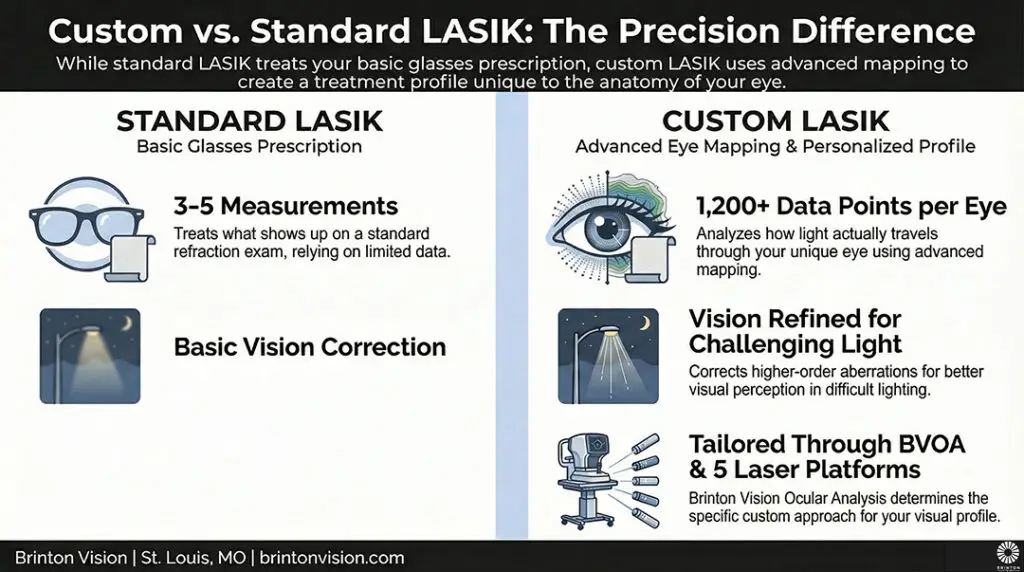
Custom LASIK in St Louis uses wavefront or topography mapping to create a treatment profile unique to each eye, correcting higher-order aberrations that standard LASIK doesn’t address. These refinements can influence overall visual perception, particularly in challenging lighting conditions. Standard LASIK treats the glasses prescription alone. In other words, standard LASIK corrects what shows up on a refraction exam, while custom LASIK looks deeper at how light actually travels through the eye. Custom procedures measure up to 1,200 unique data points per eye, compared to the 3–5 measurements in a standard correction.
Brinton Vision offers wavefront-guided, wavefront-optimized, and topography-guided custom LASIK using five laser platforms under one roof. Dr. Jason Brinton, a Harvard-trained, fellowship-trained cornea and refractive surgeon, evaluates each patient through the Brinton Vision Ocular Analysis (BVOA) to determine which custom approach fits their visual profile. That level of diagnostic detail is what allows treatment to be tailored rather than generalized.
What types of custom LASIK are available in St Louis?
Three primary types of custom LASIK are available in St Louis: wavefront-guided, wavefront-optimized, and topography-guided. Wavefront-guided maps the eye’s unique optical imperfections and corrects them individually. Wavefront-optimized preserves the cornea’s natural curvature during reshaping, while topography-guided uses corneal surface data to treat irregularities a standard prescription misses. Each type fits a different visual profile. The distinction may sound technical, but in practice it means the correction strategy can be adapted to the individual structure and optics of the eye.
Brinton Vision is the only St Louis refractive practice offering all three custom LASIK types using multiple femtosecond and excimer laser platforms. The BVOA determines which custom approach aligns with each patient’s corneal topography, prescription, and visual goals.
Is custom LASIK more accurate than standard LASIK?
Custom LASIK achieves higher precision than standard LASIK by correcting optical imperfections beyond a glasses prescription. Resolution is the key difference. The more precisely imperfections are measured, the more precisely they can be corrected. Wavefront-guided treatments measure aberrations at approximately 25 times finer detail than conventional refraction, and clinical studies show reduced higher-order aberrations and improved night vision quality in patients with larger pupils or complex prescriptions. This becomes especially important in low-light conditions, where subtle optical imperfections are more noticeable.
Dr. Brinton’s diagnostic approach begins with the BVOA, which captures over 60 diagnostic measurements to identify candidates who benefit most from custom correction. As an FDA clinical trial investigator, Dr. Brinton evaluates custom LASIK outcomes against research-grade standards.
How much more does custom LASIK cost compared to standard LASIK in St Louis?
Custom LASIK in St Louis costs more than standard LASIK eye surgery. The reason is diagnostic depth. More advanced imaging and customization require additional technology and planning time. As of 2026, the price difference ranges from several hundred to over a thousand dollars per eye, reflecting the custom technology, wavefront imaging, and personalized treatment profile involved. Most St Louis practices include custom evaluation in their quoted procedure fees. Patients should always confirm what is included in a quoted price, since technology and evaluation protocols vary between practices.
Brinton Vision includes the full BVOA in every consultation at no additional charge, determining whether custom or standard LASIK is the appropriate fit. Pricing reflects the specific technology and treatment approach recommended after diagnostic evaluation.
Which patients are better candidates for custom LASIK vs. standard LASIK in St Louis?
Patients with higher-order aberrations of the eye, larger pupil sizes, significant astigmatism, or complex prescriptions are typically better suited for custom LASIK, which addresses irregularities that standard correction can’t. Not every patient needs custom. Straightforward myopia or hyperopia within typical treatment ranges may achieve equivalent outcomes with standard LASIK. A wavefront and topography evaluation determines which approach matches each patient’s ocular profile.
The BVOA at Brinton Vision includes wavefront aberrometry, corneal topography, and pupillometry to determine each patient’s candidacy profile. Dr. Brinton personally reviews every diagnostic evaluation to determine the correction approach that matches each patient’s ocular profile.
Are you ready to take the next step in your vision journey?
What custom LASIK technology do St Louis surgeons use?
St Louis surgeons offering custom LASIK use femtosecond lasers for flap creation and excimer lasers for corneal reshaping, with custom treatments adding wavefront analyzers or topography systems for personalized treatment mapping. As of 2026, the most commonly used platforms include the ZEISS VisuMax, Alcon WaveLight, and Johnson & Johnson iDesign systems. Platform selection matters. The specific technology a practice operates determines which types of custom correction it can offer.
Brinton Vision maintains multiple femtosecond and excimer laser platforms, enabling Dr. Brinton to select the technology best matched to each patient’s correction needs. This multi-platform approach allows access to wavefront-guided, wavefront-optimized, and topography-guided treatments without referral to another practice.
Key Takeaways: Custom LASIK vs. Standard LASIK in St Louis
• Custom LASIK uses wavefront or topography mapping to correct higher-order aberrations that standard LASIK, based on glasses prescription alone, doesn’t address.
• Three types of custom LASIK are available in St Louis: wavefront-guided, wavefront-optimized, and topography-guided, each suited to different visual profiles.
• Patients with larger pupils, significant astigmatism, or complex prescriptions are typically better candidates for custom LASIK correction.
• Custom LASIK costs more than standard LASIK in St Louis, with the difference reflecting advanced diagnostic imaging and personalized treatment planning.
• The specific laser platforms a St Louis practice operates determine which custom LASIK options are available to patients.
The BVOA evaluates your eyes across multiple diagnostic tests to determine whether custom or standard LASIK aligns with your visual goals. Every patient’s eyes are different, and the right correction approach begins with understanding those differences in detail. Schedule your evaluation at Brinton Vision to take the next step toward visual freedom.