
Vision correction is one of the most personal medical decisions you’ll make — and one of the few where a bargain can cost you far more than you saved. If you’ve been searching for cheap LASIK in St. Louis, this article isn’t here to scare you away from the procedure. At Brinton Vision, we believe an informed patient makes the best patient, and that starts long before you ever sit in a surgeon’s chair. Here’s what we want you to know before you decide.
Why “Cheap LASIK” Is One of St. Louis’s Most Searched — and Most Misleading — Phrases
Search for LASIK in St. Louis and one of the first things you’ll encounter is the pricing. Ads promise laser surgery starting at $299 per eye, $499 per eye, or “as low as” figures designed to stop your scroll. It makes sense that cost is top of mind — vision correction is elective, most insurance won’t cover it, and you’re spending your own money. Finding a deal feels like smart planning.
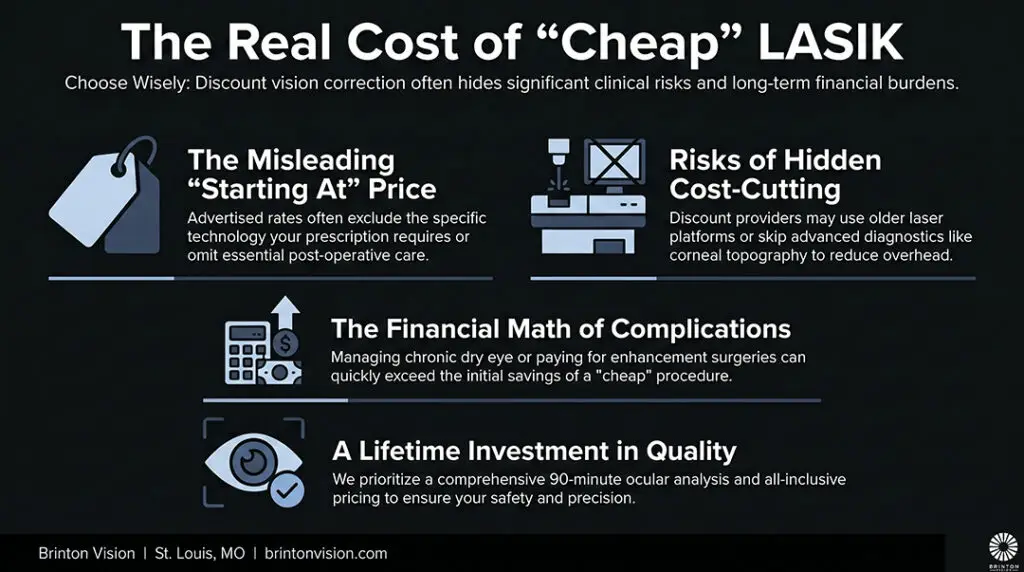
But “cheap LASIK in St. Louis” is one of those phrases where the search result and the real-world outcome rarely align. LASIK — formally, laser in situ keratomileusis — is a refractive surgery procedure that uses a laser to reshape the cornea and correct refractive errors like nearsightedness, farsightedness, and astigmatism. The advertised price rarely reflects the full picture. It typically excludes the technology your eyeglass prescription actually requires, obscures per-eye versus per-procedure distinctions in fine print, and omits the post-operative care essential to your result. What looks like a bargain in a Google ad can feel very different by the time you’re sitting in a surgeon’s chair.
The Hidden Costs Behind Discount Vision Correction
Price-first decisions in eye surgery carry a specific kind of risk that shoppers in most other markets don’t face: the consequences live in your eyes. When a discount provider cuts costs to offer below-market pricing, something absorbs that reduction — and it’s rarely the practice’s profit margin.
Common cost-cutters include older laser platforms that don’t qualify for modern FDA-cleared treatments, abbreviated eye examinations that skip state-of-the-art diagnostics, and reduced surgeon involvement in your care. Rushed pre-operative exams are particularly risky. A thorough eye examination isn’t formality — it’s how a qualified surgeon determines whether your corneal tissue, refractive error, and ocular anatomy make you a true candidate for LASIK, or whether a different procedure would deliver better accuracy and precision for your unique eyes. Corneal topography mapping, for example, reveals surface irregularities that affect treatment planning and can predict complications that no standard screening would catch.
The financial math deserves scrutiny too. Enhancement surgeries to correct undercorrections can cost nearly as much as the original procedure. Chronic dry eye — more common when pre-operative screening is rushed — means ongoing prescriptions and follow-up appointments. Patients who experience persistent halos or reduced visual acuity at night sometimes end up pursuing treatment from an entirely different ophthalmology practice than the one that performed their original surgery. None of that cost appears in the advertised price.
Real Regrets: What Patients Wish They Had Known Before Choosing on Price
The regrets that follow a price-first laser surgery decision tend to follow a familiar pattern. A patient chooses the advertised rate, discovers mid-consultation that the low price applies only to a technology tier their prescription doesn’t qualify for, feels pressure to proceed anyway, and ends up with a result that sends them back to corrective lenses within a few years — or leaves them managing visual disturbances that affect everyday life. In more serious cases, patients describe ongoing eye discomfort or pain that requires continued management long after the procedure.
Others describe consultations at discount centers that felt transactional: a quick scan, minimal treatment planning, and a push toward same-day booking. When outcomes don’t meet expectations, follow-up care is minimal or comes at additional cost. The contact lens or glasses dependency they hoped to leave behind either returns or never fully resolves.
These aren’t unusual stories. Many patients who come to Brinton Vision for consultations have already had a procedure elsewhere and are seeking either correction or clarity about what went wrong. Their most common reflection isn’t “I should have spent more money” — it’s “I should have asked better questions.”
Are you ready to take the next step in your vision journey?
What Actually Determines Vision Correction Outcomes
Three factors consistently separate excellent outcomes from disappointing ones: surgeon experience and training, the quality of diagnostic and surgical technology, and whether treatment planning was genuinely personalized to each patient’s eyes.
Not all LASIK is equivalent. Conventional laser surgery differs meaningfully from wavefront-guided LASIK, which maps the eye’s optical characteristics with a level of accuracy and precision that standard approaches can’t replicate. The diagnostic work done before surgery — including corneal topography, measurement of corneal tissue depth, and detailed refractive analysis — determines whether subtle factors are caught that could affect visual perception after surgery. A provider offering multiple procedures can match the right approach to the right eye. Personalization isn’t a marketing position; it’s a safety requirement. Safety and outcome quality are directly tied to how thoroughly the eye was evaluated before the laser was ever activated.
Questions You Should Ask Any Vision Correction Provider in St. Louis
Before committing to any eye surgery provider — including Brinton Vision — these questions will help you evaluate whether you’re being treated as an individual or as a volume case:
• What technology will be used in my specific procedure, and is it included in the quoted price?
• How many of these procedures has the surgeon personally performed, and how many per year currently?
• Will the surgeon personally conduct my eye examination, or will I primarily work with technicians?
• What is the practice’s policy on enhancement surgeries if I’m not satisfied with my result?
• What does post-operative care include, and for how long after the procedure?
• Is the quoted price all-inclusive, or are there add-ons I should anticipate?
• Does the practice accept flexible spending account (FSA) or health savings account (HSA) funds?
A provider who answers these questions confidently and transparently — with no hesitation and no pressure — is one worth trusting with your vision.
How Brinton Vision Approaches Pricing, Technology, and Patient Care
Dr. Jason P. Brinton is a Harvard-trained ophthalmologist, a leader in refractive surgery advancement, and full-time comprehensive refractive surgeon in Missouri. He is among an elite group of surgeons in the United States offering the full spectrum of cornea-based and lens-based vision correction procedures, and his training and experience include scientific publications, clinical FDA investigations, and procedures performed on patients from all over the country.
Brinton Vision is the only laser vision correction center in Missouri operating five state-of-the-art lasers and seven advanced diagnostic technologies under one roof — including the tools needed for comprehensive corneal topography and precise refractive analysis. That infrastructure supports LASIK plus all six of its modern variations: SMILE, EVO ICL, PRK, SBK, Custom Lens Replacement, and Refractive Lens Exchange with the option of Light Adjustable Lens (LAL). Rather than fitting patients into a limited menu, Dr. Brinton can recommend the procedure best suited to each patient’s corneal tissue, lens structure, and visual goals.
Pricing is all-inclusive and transparent, ranging from $2,200 to $8,200 per eye depending on the indicated treatment. There is no bait-and-switch, no fine-print technology tiers, and no high-pressure close at the end of your consultation. The practice accepts flexible spending account and health savings account funds and offers financing options to fit a range of budgets. The Brinton Vision Ocular Analysis — a comprehensive 90-minute diagnostic eye examination — ensures every recommendation begins with a complete picture of your visual health, not a rushed screening designed to move you toward a booking.
Your Vision Is a Lifetime Investment — Treat It Like One
The framing that matters isn’t “can I afford the better option” — it’s “what does it cost if I get this wrong?” Re-treatment, complications, and years of continued corrective lens or glasses dependency can quickly exceed the initial price gap between a discount center and a specialty refractive surgery practice.
Consider what glasses, contact lenses, solution, and routine eye exams actually cost over a lifetime of maintaining an eyeglass prescription. Vision correction — done well, by an experienced surgeon, with state-of-the-art technology — eliminates most of that. The improvement to visual acuity changes everyday life in ways that compound over years. That’s a different kind of investment calculation, and it’s worth doing carefully before you decide.
Ready to see what truly personalized vision correction looks like? Schedule your consultation at Brinton Vision and get honest answers about your candidacy, your options, and your investment — no pressure, no surprises. Call 314-375-2020 or visit brintonvision.com to book your Brinton Vision Ocular Analysis.